

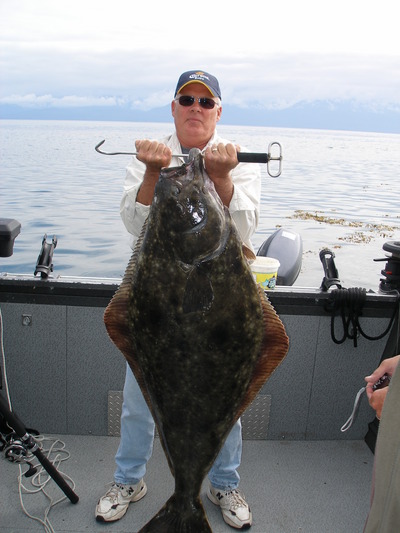
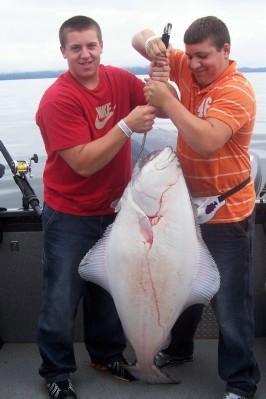
Below is a press release announcing a proposed Halibut Managing Plan that gives the recreational fisherman a "fair and equitable share" of the Halibut resource as required by the Northern Pacific Halibut Act of 1982.
"Ketchikan, Alaska August 29, 2008 Alaska charter fishermen just announceda new management alternative proposal that will stabilize the constant changes in recreational halibut fishing rules, mitigate potentially harmful economic impacts on coastal communities, andaddress conservation concerns. The proposal has numerous advantages over the present proposals being considered by the North Pacific Fishery Management Council--it is easy to understand, easy to enforce, increases safety for recreational fishermen by offering no penalty for choosing a guided-fishing option, and minimizes waste of state and federalresources by eliminating the need for extensive annual analysis and debate of management.
The charter proposal provides an alternative towhat the North Pacific Fishery Management Council will review in October when it plans to decide on an allocation for guided recreational fishermen. The NPFMC's current optionswill likely reduce daily limits to only 1-fish for both Southeast and South Central Alaska in 2009 and beyondThere is an option to lease from commercial fishermen the 'right' to catch a second halibut.Charter fishermen feel the original options do not reflect the Northern Pacific Halibut Act of 1982, whichrequires the allocation of halibut fishing privileges be fair and equitable.Since 1995, commercial fishermen have caught an average of 89 percent of all halibut off the coast ofAlaska.
As a result, charter fishermen are offering theiralternative proposal allowing a more equitable access to the publicresource. Elements of the plan include:
- All recreational fishermen(guided and unguided) would have the same daily bag limits for all areas offAlaska, withno slot or annual limits. There would be no bias against those who are disabled, cannot afford their ownboats or otherwise preferor need a guided fishing experience.
- Fair public access to the resource "as it has been for decades, the recreational daily bag limit of two fish," unlessthe coastwide halibut spawning biomass declined to the point thatconservation became a concern.
- In years of higher-than-usual halibutabundance, the commercial fishery would harvest all additional fish available.
- Automatic regulation in a conservation crisis--the recreational daily bag limit wouldautomaticallybe reduced to a one fish per day. A conservation concern as definedby the IPHC estimating acoastwide halibut spawning biomass is less than 225 million pounds, or B30).
- Conservation to rebuild the stocks in years of critically low biomass. If the coastwide halibut spawning biomass is estimated by the IPHC to be below 225 million pounds (B30) for any particular year, the IPHC would be directed to:
- Reduce the recreational daily limit offAlaskato one halibut per day.
- Reduce the commercial bycatch by the same percentage as the directed commercial catch limit is reduced, based on the average reduction for all Alaskan IPHC areas.
- Ensure the realized commercial harvest rate is the same as the target commercial harvest rate.Currently,apolicy called "slow up, fast down" buffers the economic impacts on the commercialindustry allowing them toharvest beyond the targeted allocation.
- Ensure the halibut not caught byrecreational fishermenas a result of a 1-fish daily limit remain unharvested, staying in the ocean torebuild the spawning stocks. Currently, fish not harvested by recreational fishermen as a result of reduced daily limits get reallocated for harvest bycommercial fishermen and do not remain in the ocean).
- Reduce the recreational daily limit offAlaskato one halibut per day.
The proposed rule will also benefit Alaskans who don't live incoastal areasor who can't take an unguided boat fishing for halibut.It benefits coastal businesses who rely on anglers coming toAlaskato fish.GovernorPalinhas stated that "sportfishing is a significant element ofAlaska's economy, creating more than 12,000 jobs and with a total annual economic impact of more than $1 billion." Of the 502,000 sport fishing licenses the State ofAlaskasells each year, 315,000 go to non-resident anglers spending tourism dollars inAlaska. Some of the larger lodge operators individually spend over $5 million dollars annually buying local goods and services. Many mid-size businesses may each spend between $1 million and $3 million annually.
While commercial fishermen have been advocating a 1-fish daily limit for conservation reasons, in actuality reducing the recreational fishing limit will not keep any additional halibut in the oceanthe additional fish will be reallocated to the commercial fishery.
"Certainly, it would be neither environmentally responsible nor good for our businesses if the charter industry was seeking a two-fish limit when the resource was in danger. Regulatory officials repeatedly stated this is not the case. In fact, in our area, the biomass is projected to increase over the next 10 years," declaredScottVan Valin, owner of El Capitan Lodge and co-founder of the Charter Halibut Task Force."
YOU can help save your right to public access to the Halibut resource, the one comment we have continually faced was that the public doesn't seem to feel they are being treated unfairly. Email the addresses below and let them know that you support the "proposed management plan from the Charter Halibut Task Force". Let them know that you should not be treated differently because you want a guided fishing trip.
Alaska Governor Sara Palin: governor@gov.state.ak.us
Alaska Senator Ted Stevens: http://stevens.senate.gov/public/index.cfm?FuseAction=Contact.EmailSenatorStevens
Alaska Senator Lisa Murkowski: http://murkowski.senate.gov/public/index.cfm?FuseAction=ContactMe.EMailLisa
Fish & Game Commissioner Denby Lloyd: denby.lloyd@alaska.gov
National Marine Fisheries Sue Salveson:sue.salveson@noaa.govJust a few emails from every sport fisherman would let them know that we do value our right to fish and that access to a public resource does NOT mean buying it at the store.
Thank You for your support.